Post
Post-Trained Evaluators: How to Monitor Production Agents Without Burning Your Budget
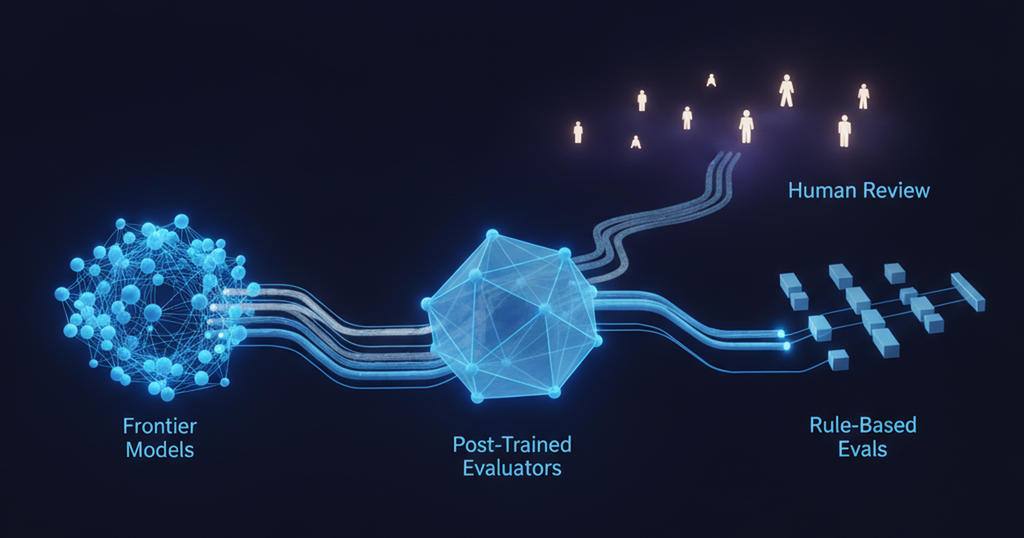
Production agent monitoring has a brutal cost-accuracy trade-off. Frontier models (Claude, GPT) give you high-quality judgments but burn money at scale. Rule-based evals are cheap but brittle. Human review doesn't scale past hundreds of traces per day.
Enjoying the field notes? Subscribe for each new deep dive.Subscribe →
Post-Trained Evaluators: How to Monitor Production Agents Without Burning Your Budget
Production agent monitoring has a brutal cost-accuracy trade-off. Frontier models (Claude, GPT) give you high-quality judgments but burn money at scale. Rule-based evals are cheap but brittle. Human review doesn't scale past hundreds of traces per day.
LangChain just shipped a solution: a custom post-trained model for detecting issues in production agent traces, achieving "SOTA accuracy at ~10-100x cheaper rates than frontier models" (per Harrison Chase at https://x.com/hwchase17/status/2066572458422100017).
The architecture mirrors patterns from LinkedIn's SAGE framework (arXiv:2602.07840), which distilled frontier LLM reasoning into an 8B-parameter student judge that achieved 0.72 (Job Search) and 0.73 (People Search) Cohen's kappa vs. expert humans—approaching the GPT-o3 teacher's 0.77 kappa—while running at 92× lower cost. The technique is task-specific distillation: use a frontier model to label a curated dataset, then post-train a small model to replicate that judgment. (Note: SAGE measured these kappas on search result relevance tasks, not agent trace evaluation—the pattern generalizes, but independent validation on agent traces is not yet published.)
This isn't just a cost optimization. It's an enabling technology. Without cheap, accurate trace evaluation, you can't monitor agents in production at the scale required to catch failures before users do.
The Production Monitoring Problem
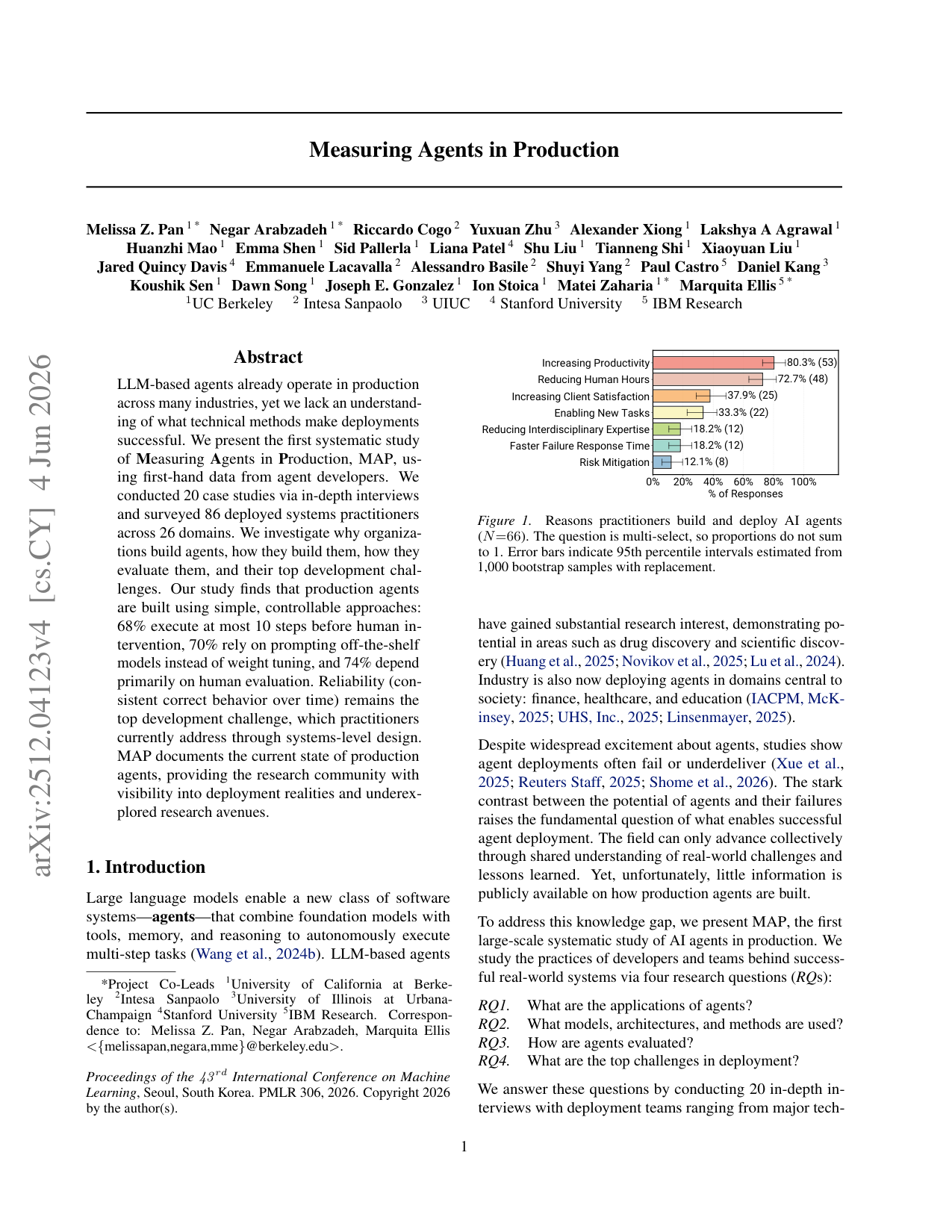
Per arXiv:2512.04123 ("Measuring Agents in Production"), 74% of production teams depend primarily on human evaluation. But human review doesn't scale cleanly:
- Human review: High accuracy, doesn't scale past hundreds of traces/day, introduces latency
- LLM-as-a-judge (frontier): High accuracy, expensive at volume, latency can be prohibitive
- Rule-based evals: Cheap, fast, brittle (miss nuanced failures, generate false positives)
The production reality: you're generating thousands to millions of agent traces per day. You need to detect: - Tool call failures (wrong parameters, invalid API responses) - Reasoning failures (hallucinated steps, logic errors) - Safety violations (leaked PII, policy breaches) - Quality degradation (correct but suboptimal answers)
You need to do this cheaply (or the monitoring cost exceeds the agent cost) and accurately (or the noise buries real failures and teams stop trusting the alerts).
The Distillation Solution: SAGE as Blueprint
LinkedIn's SAGE framework (arXiv:2602.07840, published for KDD '26) operationalized this pattern for search relevance evaluation. The architecture:
- Policy (𝒫): Natural-language specification of what constitutes a good vs. bad result
- Precedent (ℰ): Small curated dataset (few hundred examples) of canonical judgments from domain experts
- Teacher Judge: Frontier LLM (GPT-o3) that executes the policy against precedent
- Student Judge: 8B-parameter open-source model, full-parameter fine-tuned on teacher labels
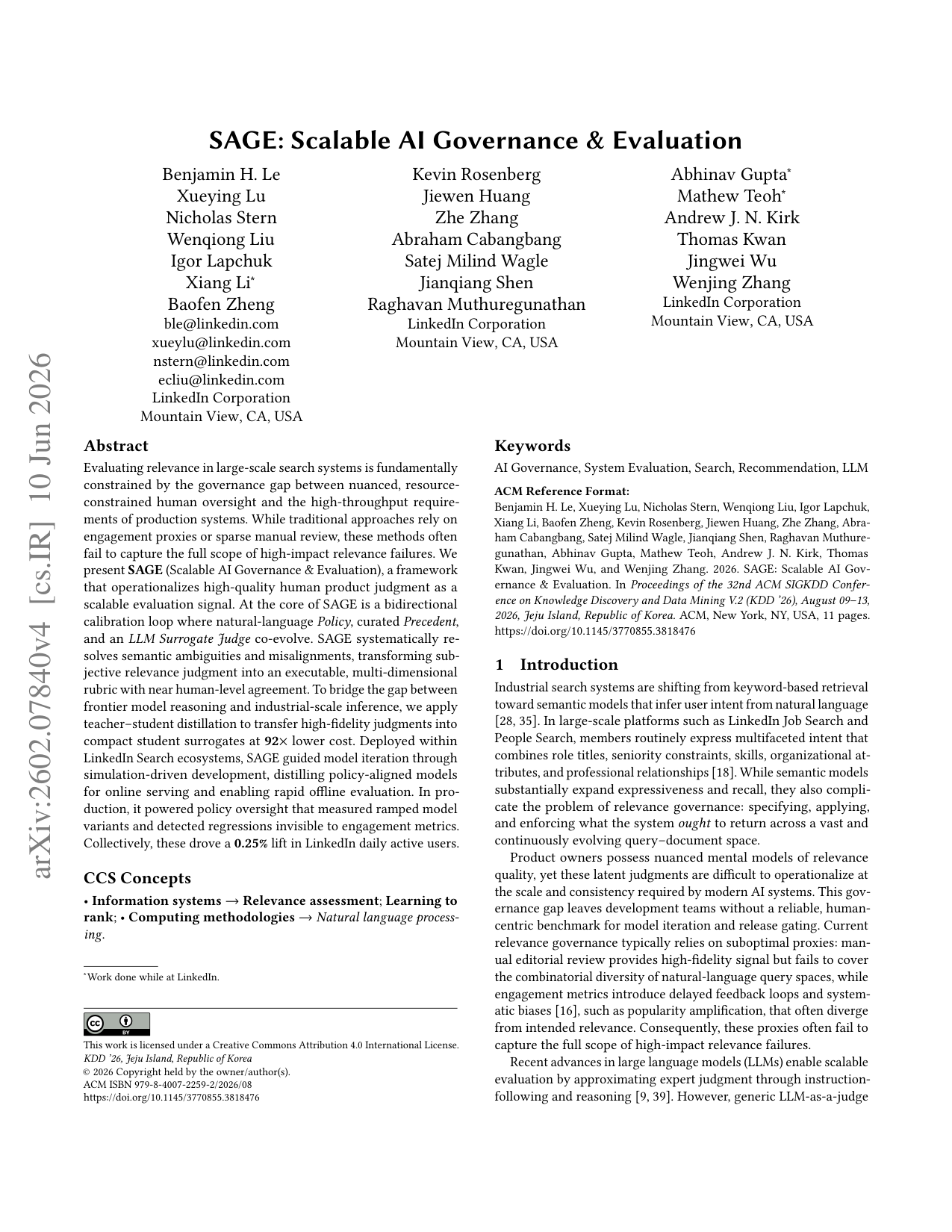
Key results: - Teacher-Human agreement: 0.77 Cohen's kappa (approaching expert ceiling of 0.83) - Student-Human agreement: 0.72 (Job Search), 0.73 (People Search) - Cost: 92× cheaper than teacher, 154× cheaper than human evaluation - Scale: >10^7 annotations/day offline, >10^4 QPS online - Business impact: +0.25% lift in LinkedIn Daily Active Users (DAU)
The breakthrough is bidirectional calibration: Policy guides Precedent curation; Precedent disagreements expose policy ambiguities; Judge misalignment drives policy updates. All three components (Policy, Precedent, Judge) co-evolve to minimize alignment divergence.
Why Full-Parameter Fine-Tuning Matters
SAGE used full-parameter fine-tuning (not LoRA) on a 312K-example training corpus with rebalanced score classes. The insight: task-specific judges benefit from deep model adaptation, not just surface-level alignment. The student learns to internalize the policy, not just mimic the teacher's outputs.
LangChain's Post-Trained Trace Evaluator
LangChain's announcement (https://x.com/hwchase17/status/2066572458422100017) follows the same pattern:
"Detecting issues in production agent traces is hard. You have to do it cheaply (because of volume) but also accurately (or too much noise). We post-trained our own model for this. SOTA accuracy, at ~10-100x cheaper rates than frontier models."
The architecture (inferred from public details and SAGE precedent):
- Curated trace dataset: Production traces from LangSmith customers, labeled by frontier models or human experts (successes, failures, edge cases)
- Evaluation rubric: Explicit criteria for trace quality (tool call correctness, reasoning coherence, policy compliance)
- Teacher labels: Frontier model (Claude/GPT) generates judgments on the dataset
- Student model: Small open-source backbone (likely 7B-13B range), post-trained on teacher labels
- Deployment: Student runs in LangSmith's production monitoring pipeline, flagging anomalies for human review
Expected cost-accuracy profile (based on SAGE): - 10-100× cheaper than frontier models - Agreement with frontier judges/humans approaching teacher-level performance (SAGE student achieved 0.72-0.73 vs. teacher's 0.77 on search relevance tasks) - Latency under 100ms for real-time quality control
One commenter nailed the trade-off: "cheap + accurate or cheap + mostly accurate? one of those works way harder." The answer: cheap + accurate is achievable via distillation, but only if you invest in high-quality precedent and continuous calibration.
The Evaluation Rubric: Decomposed Attributes
Per SAGE, the key to explainability and accuracy is decomposing relevance into orthogonal attributes. For agent traces, this might look like:
- Tool Call Validity: Parameters match schema, API response indicates success
- Reasoning Coherence: Steps follow logically, no contradictions
- Policy Compliance: No PII leaks, no disallowed actions
- Answer Quality: Addresses user query, cites sources, admits uncertainty appropriately
Each attribute gets an independent score (0-4 graded scale). Weighted heuristics derive the final judgment. This eliminates black-box opacity and enables targeted failure attribution during calibration.
Pseudo-Code: Trace Evaluation Schema
The following is illustrative pseudo-code, not a runnable API. The per-attribute scoring methods (score_tools, score_reasoning, score_compliance, score_quality) are abstract hooks—in a real system, each would invoke your post-trained student model with the relevant slice of the trace. Here they're stubbed to return a placeholder score so the aggregation logic is clear:
class TraceEvaluator:
    def __init__(self, policy, student_model):
        self.policy = policy        # Evaluation rubric
        self.model = student_model  # Post-trained judge

    # --- Abstract scoring hooks ---------------------------------------
    # In production, each of these would call self.model with the
    # relevant slice of the trace and the matching rubric section,
    # returning a 0-4 graded score. Stubbed here for illustration.
    def score_tools(self, tool_calls):
        return self.model.score(self.policy["tool_validity"], tool_calls)

    def score_reasoning(self, steps):
        return self.model.score(self.policy["reasoning"], steps)

    def score_compliance(self, actions):
        return self.model.score(self.policy["compliance"], actions)

    def score_quality(self, output, user_query):
        return self.model.score(self.policy["quality"], (output, user_query))
    # ------------------------------------------------------------------

    def evaluate(self, trace):
        # Decomposed scoring
        scores = {
            "tool_validity": self.score_tools(trace.tool_calls),
            "reasoning":     self.score_reasoning(trace.steps),
            "compliance":    self.score_compliance(trace.actions),
            "quality":       self.score_quality(trace.output, trace.user_query),
        }

        # Weighted aggregation
        final_score = (
            0.3 * scores["tool_validity"] +
            0.3 * scores["reasoning"] +
            0.2 * scores["compliance"] +
            0.2 * scores["quality"]
        )

        # Flag if below threshold
        if final_score < 3.0:
            return {"status": "FLAGGED", "scores": scores, "trace_id": trace.id}
        return {"status": "OK", "scores": scores}

Bidirectional Calibration: Continuous Improvement
The SAGE framework emphasizes that evaluation is not a one-time setup. It requires continuous calibration:
Four Feedback Vectors
- Human → Policy (Policy Intuition Gaps): Expert annotators flag instances where policy contradicts domain intuition → policy updates
- Human → Human (Policy Ambiguity Detection): Inter-rater agreement (Cohen's kappa) identifies policy under-specification → clarifications
- Judge → Precedent (Adversarial Audit): Judge disagreements surface human labeling errors → precedent corrections
- Judge → Policy (Edge-Case Discovery): Judge reasoning failures identify policy gaps → extensions
In SAGE's deployment, four calibration iterations improved Cohen's kappa from 0.67 (baseline G-Eval-style GPT-o3) to 0.77 (final teacher), with each iteration addressing specific failure modes.
For LangChain's trace evaluator, this means: - Monitor disagreements between student and escalated human review - Retrain student periodically on new failure modes - Update evaluation rubric as agent patterns evolve (new tool types, new reasoning strategies)
When Distilled Evaluators Make Sense
Not every evaluation task justifies post-training a custom model. The pattern works when:
- High volume: You're evaluating thousands+ of instances per day (amortizes training cost)
- Well-defined rubric: You can articulate what "good" vs. "bad" looks like (enables labeling)
- Frontier-model labels available: You can afford to run GPT/Claude on a curated dataset (seeds the student)
- Cost sensitivity: Frontier-model evaluation at scale is prohibitive (justifies distillation)
- Continuous deployment: You need real-time or near-real-time feedback (latency matters)
For one-off evals, offline benchmarking, or low-volume use cases, frontier models or human review are simpler.
Production Evidence: Human Evaluation Remains Central
Per arXiv:2512.04123, 74% of production teams depend primarily on human evaluation. The common pattern: LLM judge scores confidence → route low-confidence cases to humans → human experts sample a percentage (e.g., 5%) even when LLM confidence is high.
Distilled evaluators fit naturally into this hybrid workflow: - Student model runs on 100% of traces (cheap, fast) - Flags high-risk traces for human review (confidence threshold) - Periodically samples "OK" traces for audit (catch drift, retrain)
The Bigger Pattern: Specialized Judges Beat Generalists
Generic LLM-as-a-judge (zero-shot GPT/Claude) suffers from domain mismatch. The model wasn't trained on your task, your rubric, or your edge cases. Prompting helps but doesn't close the gap.
Task-specific post-training addresses this: - Model internalizes your rubric (not just surface-level pattern matching) - Training data includes your failure modes (not just general reasoning) - Calibration loop ensures ongoing alignment (not one-shot tuning)
LinkedIn's SAGE results confirm: a post-trained 8B student approached GPT-o3 teacher performance (0.72-0.73 vs. 0.77 kappa on search relevance) at 92× lower cost. The generalist frontier model is overkill for a well-scoped evaluation task.
Code Pattern: Integrating a Distilled Evaluator
The snippet below is conceptual pseudo-code sketching how a distilled evaluator would plug into a monitoring pipeline. The class names, model path, and config file are placeholders, not real LangSmith APIs—consult the official LangSmith SDK docs (https://docs.smith.langchain.com/) for the actual evaluator and tracing interfaces:
import os

# --- Placeholder objects (not real LangSmith APIs) ----------------
# In a real integration, replace these with the official LangSmith
# SDK's evaluator + tracing primitives.
class PostTrainedEvaluator:
    """Wraps your post-trained student judge behind a score() call."""
    def __init__(self, model_path, rubric_path):
        self.model_path = model_path   # e.g. local/registry path to 8B student
        self.rubric_path = rubric_path # decomposed-attribute rubric

    def evaluate(self, trace):
        ...  # run student model, return decomposed + aggregated scores

def monitoring_pipeline(evaluator, alert_threshold, sample_rate):
    """Conceptual harness: score traces, alert, and audit a sample."""
    ...
# ------------------------------------------------------------------

evaluator = PostTrainedEvaluator(
    model_path="path/to/your/trace-judge-8b",  # your distilled student
    rubric_path="eval_rubric.yaml",            # your decomposed rubric
)

pipeline = monitoring_pipeline(
    evaluator=evaluator,
    alert_threshold=3.0,  # flag traces scoring <3.0 (0-4 scale)
    sample_rate=0.05,     # audit 5% of OK traces
)

# Conceptual flow:
#   trace -> evaluator.evaluate(trace) -> aggregate score
#   if score < alert_threshold: route to human-review dashboard
#   else: with probability sample_rate, sample for audit
When NOT to Distill
Distillation has costs: - Training overhead: Labeling dataset, training infrastructure, calibration iterations - Maintenance burden: Retrain as rubric evolves, monitor for drift - Specialization lock-in: Student is task-specific; doesn't generalize to new evaluation tasks
When does it NOT make sense? - Low-volume evaluation (<1K traces/day) - Rapidly changing rubric (haven't converged on what "good" means) - One-off experiments (training cost exceeds usage cost)
For these cases, stick with frontier models, rule-based evals, or human review.
Sources & Further Reading
- Harrison Chase on X (LangChain post-trained trace evaluator announcement): https://x.com/hwchase17/status/2066572458422100017 — "SOTA accuracy, at ~10-100x cheaper rates than frontier models"
- arXiv:2602.07840 - SAGE: Scalable AI Governance & Evaluation (LinkedIn, KDD '26): https://arxiv.org/html/2602.07840 — Complete framework for distilling frontier LLM reasoning into 8B student judge; teacher 0.77 kappa, student 0.72-0.73 kappa, 92× cost reduction
- arXiv:2512.04123 - Measuring Agents in Production: https://arxiv.org/html/2512.04123v1 — Survey of 86 practitioners on evaluation methods; 74% depend primarily on human evaluation
- LangChain: "You don't know what your agent will do until it's in production": https://www.langchain.com/blog/production-monitoring — Context on production monitoring challenges and LangSmith's observability approach
Get the next deep dive in your inbox
Field notes on shipping agentic AI — no spam, unsubscribe anytime.