Post
Multi-Model Fusion Systems Challenge the Frontier Pareto Curve
Frontier models may not own all the best points on the cost-accuracy Pareto curve—and they may not be on the curve at all.
Enjoying the field notes? Subscribe for each new deep dive.Subscribe →
Multi-Model Fusion Systems Challenge the Frontier Pareto Curve
Frontier models may not own all the best points on the cost-accuracy Pareto curve—and they may not be on the curve at all.
On June 12, 2026, OpenRouter released Fusion, a multi-model deliberation system that synthesizes outputs from multiple LLMs running in parallel. Testing on the DRACO deep research benchmark revealed a striking result: a panel of Fable 5 + GPT-5.5, synthesized by Opus 4.8, achieved 69.0% accuracy—surpassing every individual model tested, including Fable 5's solo score of 65.3% (per OpenRouter blog). More provocatively, a budget panel of three mid-tier models (Gemini 3 Flash, Kimi K2.6, DeepSeek V4 Pro) scored 64.7%—coming within 1% of Fable 5's score while outperforming both GPT-5.5 (60.0%) and Opus 4.8 (58.8%) standalone, at approximately 50% of the cost.
Jerry Liu (@jerryjliu0 on X) called the release "insane" and "not just because it's perfect timing." His key observation: "frontier models alone do not own all the points on the cost-accuracy Pareto curve for knowledge work tasks; in fact they may not be on the Pareto curve at all. The Pareto curve may be defined by a mixture of models, which any independent third-party (e.g. an AI startup) has access to but the model labs do not" (per @jerryjliu0 on X, June 15, 2026).
This reframes the competitive landscape. If orchestration intelligence—how you coordinate multiple models—matters more than access to a single frontier model, then differentiation moves from model weights to workflow design. And any startup with API access can compete.
How Fusion Works
Fusion transforms a single prompt into a parallel multi-model deliberation (per OpenRouter):
- Parallel dispatch: A panel of expert models (default: 6 in the Quality preset) analyzes the prompt simultaneously, with web search and web fetch enabled.
- Structured analysis: A judge model synthesizes their responses into a structured analysis covering consensus points, contradictions, partial coverage, unique insights, and blind spots.
- Final answer: The judge writes a final response grounded in the synthesis.
The entire pipeline runs server-side and is callable like a single model via OpenAI-compatible API. The simplest call uses the default panel:
{
  "model": "openrouter/fusion",
  "messages": [
    {"role": "user", "content": "What are the strongest arguments for and against carbon taxes?"}
  ]
}
Custom panels are configured via the plugins parameter (per OpenRouter blog):
{
  "model": "openrouter/fusion",
  "messages": [{"role": "user", "content": "..."}],
  "plugins": [{
    "id": "fusion",
    "model": "google/gemini-3-flash-preview",
    "analysis_models": [
      "google/gemini-3-flash-preview",
      "moonshotai/kimi-k2.6",
      "deepseek/deepseek-v4-pro"
    ]
  }]
}
The architecture in words: a prompt enters, fans out to N models running in parallel (each with web search enabled), and those N independent responses are then read by a judge model that produces a structured meta-analysis—consensus, contradictions, partial coverage, unique insights, blind spots—before writing the final answer grounded in that synthesis. The models remain fully separate; nothing is merged at the parameter level.
Why Model Diversity Beats Solo Frontier Models
OpenRouter attributes the performance gain to "model diversity, similar to the benefits seen on human team performance. Bringing multiple different perspectives to complex problems yields superior results" (per OpenRouter blog).
The DRACO benchmark—100 deep research tasks across 10 domains: academic research, finance, law, medicine, technology, UX design, general knowledge, needle-in-a-haystack retrieval, personalized assistance, and product comparison—tests what Fusion is built for: researching complex questions, synthesizing multiple sources, and producing comprehensive, well-cited analysis. Evaluation criteria (~39 weighted factors across 4 categories: factual accuracy, breadth/depth, presentation quality, and citation quality) penalize dangerous errors with negative weights, making verbosity-gaming impossible (per OpenRouter blog).
Complete DRACO results (per OpenRouter blog):
| Type | Model(s) | Score |
|---|---|---|
| Fusion | Fable 5 + GPT-5.5 (judge: Opus 4.8) | 69.0% |
| Fusion | Opus 4.8 + GPT-5.5 + Gemini 3.1 Pro (judge: Opus 4.8) | 68.3% |
| Fusion | Opus 4.8 + GPT-5.5 (judge: Opus 4.8) | 67.6% |
| Fusion | Budget panel: Gemini 3 Flash + Kimi K2.6 + DeepSeek V4 Pro (judge: Opus 4.8) | 64.7% |
| Solo | Claude Fable 5 | 65.3% |
| Solo | DeepSeek V4 Pro | 60.3% |
| Solo | GPT-5.5 | 60.0% |
| Solo | Claude Opus 4.8 | 58.8% |
Panels consistently outperform their strongest constituent. Even a panel of two identical Opus 4.8 instances, synthesized by a third Opus 4.8, scored 65.5%—beating Opus solo's 58.8% by 6.7 points (per OpenRouter blog). This suggests synthesis itself—not just architectural diversity—adds value, though the causal mechanism (whether it reflects judge-model clarification, structured breakdown of a single perspective, or extended reasoning time) requires further study.
The Pareto Curve Implication
Liu's analysis: Fusion is "extremely horizontal and is not even well-tuned for a specific task. You can prompt the Fusion API with anything. This just means that for any given workflow subset, there's even greater alpha to exploit, by hillclimbing a task-specific benchmark. The more specific the workflow, the more hillclimbing you can do" (per @jerryjliu0 on X).
Consider invoice reconciliation at scale. A task-specific mixture—one model for document extraction, another for line-item validation, a third for contract matching—can be "orders of magnitude cheaper and more reliable than 'raw' Claude" (per Liu). That alpha is exploitable by any company that isn't a frontier lab.
This connects to broader trends in the OpenRouter 100-trillion-token study (arXiv:2601.10088v1). The report, analyzing real-world LLM usage across 2025, found that reasoning models grew from negligible in Q1 2025 to exceed 50% of all token traffic by late 2025, and that agentic inference patterns—tool-calling, long prompts (average prompt tokens grew approximately 4x from ~1.5K to over 6K), multi-step workflows—have surged significantly, now central to production inference patterns. Within the open-source segment specifically, model selection has become pluralistic: no single open-source model holds over 25% of OSS token volume anymore (per OpenRouter State of AI 2025 report, arXiv:2601.10088v1).
See arXiv:2601.10088v1 for the full empirical analysis.
Fusion extends this pluralism from model choice to model coordination. Instead of betting on one frontier model, systems can now bet on orchestration patterns that compose models dynamically.
Ensemble Learning, Parameter Merging, and Multi-Model Deliberation
Three distinct paradigms are often conflated here; Fusion is the third, not a variant of the first two.
Ensemble learning saves all individual models and fuses their predictions at inference time—each model runs independently and outputs are aggregated (by voting, averaging, or stacking). The models themselves are never combined.
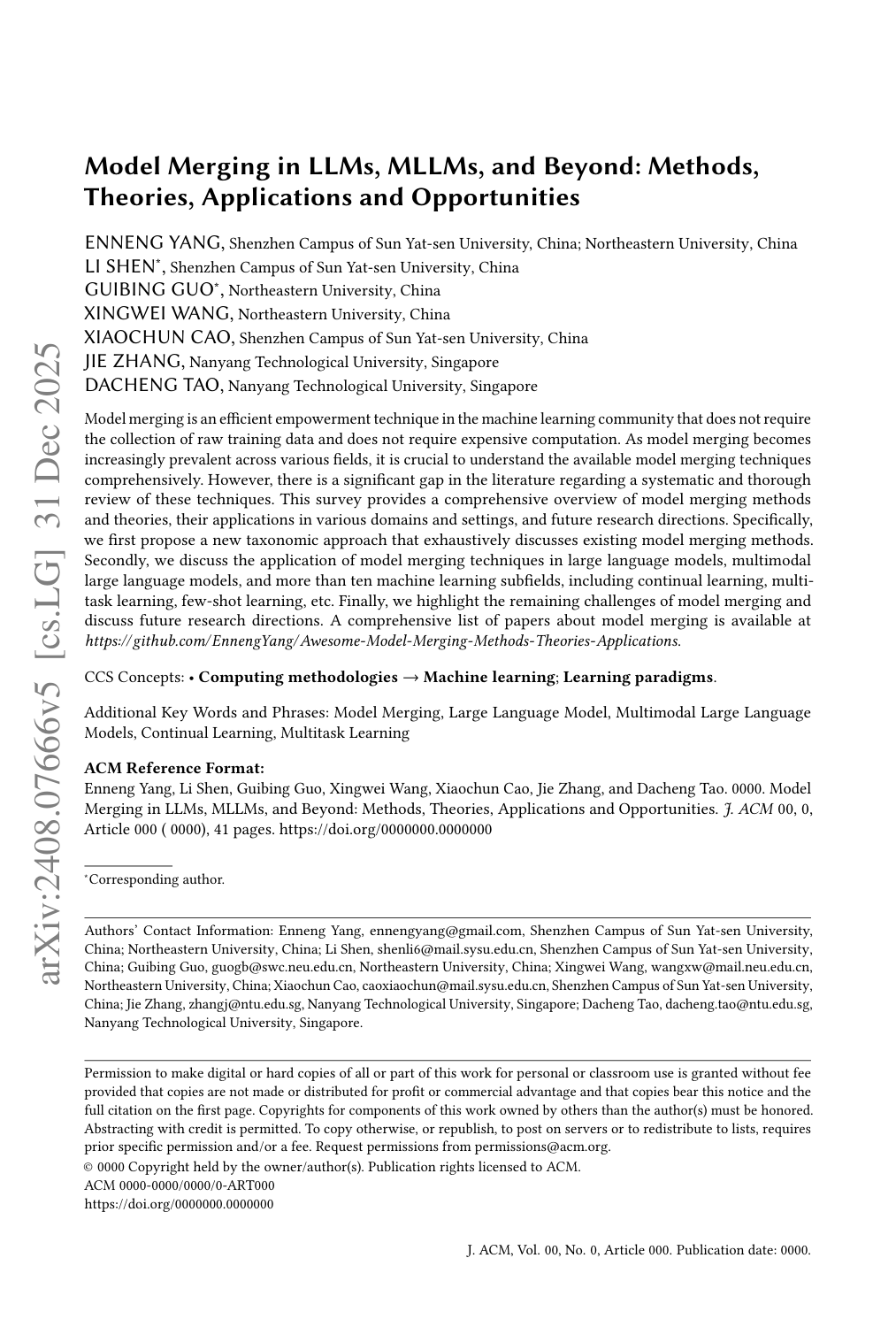
Parameter-level model merging takes a different approach: it merges model weights directly at the parameter level to create a single unified model, without needing the original training data (per arXiv:2408.07666v1, "Model Merging in LLMs, MLLMs, and Beyond"). The result is one model whose weights encode knowledge from the merged sources.
Multi-model deliberation (OpenRouter Fusion) is a third, distinct category. The models remain entirely separate—no weights are merged. Instead, each model produces an independent response to the same prompt, and a judge model reads all responses and synthesizes a structured meta-analysis (consensus, contradictions, blind spots) before writing the final answer. This is closer to how a human research team operates: diverse independent perspectives, explicit conflict identification, and deliberate synthesis into a coherent deliverable.
The judge model's role is what makes Fusion distinct. It doesn't vote or average; it produces a qualitative structured analysis and then writes a new grounded response from that analysis.
Practical Considerations
Cost structure: Because Fusion runs every panel member plus a judge call, requests are priced as the sum of those underlying completions, not as a single model (per OpenRouter). The budget panel achieving near-Fable performance at half the cost suggests careful panel design can move both left (cheaper) and up (more accurate) on the Pareto curve.
When to use: OpenRouter recommends Fusion "when a single model isn't enough—research, expert critique, or anywhere the cost of being wrong outweighs a few extra completions" (per OpenRouter).
Contamination prevention: OpenRouter discovered that models were finding the DRACO grading rubric online via web search during evaluation. They blocked rubric-hosting domains using excluded_domains and blocked_domains parameters in their server-side tool definitions (per OpenRouter blog). This is a reminder that agent tooling must account for adversarial information access.
Where This Goes
If the Pareto frontier is defined by mixtures rather than monoliths, then:
- Startups can compete on orchestration without frontier model access.
- Workflow-specific tuning becomes the differentiation layer.
- Multi-model coordination primitives (panel selection, judge model choice, synthesis strategies) become core IP.
- Evaluation shifts from "which model is best" to "which mixture solves this workflow class."
The competitive question is no longer "Do you have Fable 5 access?" It's "How intelligently can you compose the models you do have access to?"
Sources & further reading
- OpenRouter Fusion model page: https://openrouter.ai/openrouter/fusion
- OpenRouter blog: "Surpassing Frontier Performance with Fusion": https://openrouter.ai/blog/announcements/fusion-beats-frontier/
- Jerry Liu on X: https://x.com/jerryjliu0/status/2066363868683866503
- OpenRouter State of AI 2025 report & arXiv:2601.10088v1: https://openrouter.ai/state-of-ai, https://arxiv.org/html/2601.10088v1
- "Model Merging in LLMs, MLLMs, and Beyond" (arXiv:2408.07666v1): https://arxiv.org/html/2408.07666v1
Get the next deep dive in your inbox
Field notes on shipping agentic AI — no spam, unsubscribe anytime.