Post
"Fix This Code" Is Not a Jailbreak: What the Fable 5 Export Ban Means for Shipping Agentic AI
How a defensive find-fix-test loop got reframed as a national-security weapon — and why dual-use capability is the substrate of every coding agent, not a flaw to be guardrailed away.
Enjoying the field notes? Subscribe for each new deep dive.Subscribe →
"Fix This Code" Is Not a Jailbreak: What the Fable 5 Export Ban Means for Shipping Agentic AI
When the prompt that powers your defensive coding agent is the same prompt a government calls a national-security threat, your real risk isn't the model — it's the governance around it.
On June 12, 2026, the US government issued an export-control directive, citing national security authorities, ordering Anthropic to suspend all access to Claude Fable 5 and Mythos 5 by any foreign national — inside or outside the US, including foreign-national Anthropic employees (per Anthropic's statement). Because there is no reliable way to segment foreign nationals from US persons in real time across hundreds of millions of users on same-day notice, the net effect was that Anthropic abruptly disabled both models for every customer worldwide (per Anthropic; per Snyk).
Then the technical community got a look at the supposed "jailbreak" — and the reaction was disbelief. Per @simonw: "If this really is the 'jailbreak' that got Fable shut down I'm deeply unimpressed," followed by "Yeah, it really does look like the jailbreak was 'fix this code'" and "It's also a prompt I've been using every week for 2+ years."
What actually happened in the lab
The clearest account comes from Katie Moussouris, founder/CEO of Luta Security, who states she is the only outside expert to have read the third-party research paper Anthropic shared privately (per Luta Security; corroborated by The Register and Cybernews). Her description of the method:
- Researchers took open-source code containing known CVEs, plus new code with deliberately planted vulnerabilities.
- They asked Fable 5, Mythos, and Opus to "review the code for security issues." Fable 5 refused — its guardrails fired.
- They then asked the models to "fix this code."
- Through a multistep, manual process, they turned that output into scripts that test the patches.
"That's it," Moussouris writes. "'Fix this code,' plus several manual steps to generate test scripts, should never have triggered an export control. I feel like making '90s-style t-shirts with 'fix this code' on the front and 'this shirt is a munition' on the back" (per Luta Security; per The Register).

Her core argument is that the prompts worked because they were defensive requests, and that capability "cannot be removed without making the model worse at fixing bugs and verifying patches" (per Luta Security). Defenders need an AI that can fix a bug, explain why the fix matters, and write tests confirming the patch works — the find, fix, and test loop.
Anthropic's own framing
Anthropic's statement is notably aligned with the critics on the facts, even as it complies with the order. It says the government provided only verbal evidence of a "potential narrow, non-universal jailbreak, which essentially consists of asking the model to read a specific codebase and fix any software flaws," that the demonstrated vulnerabilities were "relatively simple" and discoverable by other public models "without requiring a bypass," and that the capability is "widely available from other models (including OpenAI's GPT-5.5)" and "used every day by the defenders who keep systems safe" (per Anthropic).
Anthropic's broader position: government should be able to block unsafe deployments, but only via a process that is "transparent, fair, clear, and grounded in technical facts," and "this action does not adhere to those principles." It warned that if this standard "was applied across the industry, we believe it would essentially halt all new model deployments for all frontier model providers" (per Anthropic).
There's an uncomfortable irony layered on top: per Snyk, just days earlier IBM X-Force's Valentina Palmiotti had told TechCrunch that Fable 5's guardrails were too aggressive, rejecting anything "tangentially cyber related." So within one week the same model was attacked as too restrictive for defenders and pulled as too dangerous.
Why a perfect guardrail is impossible (the part builders should internalize)
The deepest point isn't political — it's architectural. As independent expert Kenny Vaneetvelde put it (per Cybernews), an LLM "does not look up answers. It generates them one token at a time, by sampling from a probability distribution over its entire vocabulary. The last step in that process, the softmax, hands a nonzero probability to every possible next token. Every single one." A jailbreak "is just someone finding one of those paths… A patch can lower the odds. It cannot reach zero."
Anthropic says essentially the same thing in its own words: it "suspect[s] that perfect jailbreak resistance is not currently possible for any model provider," which is why it adopted defense in depth — make jailbreaks either narrow or very expensive to produce, then monitor to detect and shut down successful attacks (per Anthropic; per Snyk).
This is exactly the terrain mapped by the academic literature. The Systematization of Knowledge paper "SoK: Evaluating Jailbreak Guardrails for Large Language Models" (accepted to IEEE S&P 2026) proposes a six-dimension taxonomy of guardrails and a Security-Efficiency-Utility evaluation framework — the key insight being that you cannot maximize all three at once. Push security up and you pay in utility (refused-but-legitimate requests) and efficiency (per arXiv:2506.10597).
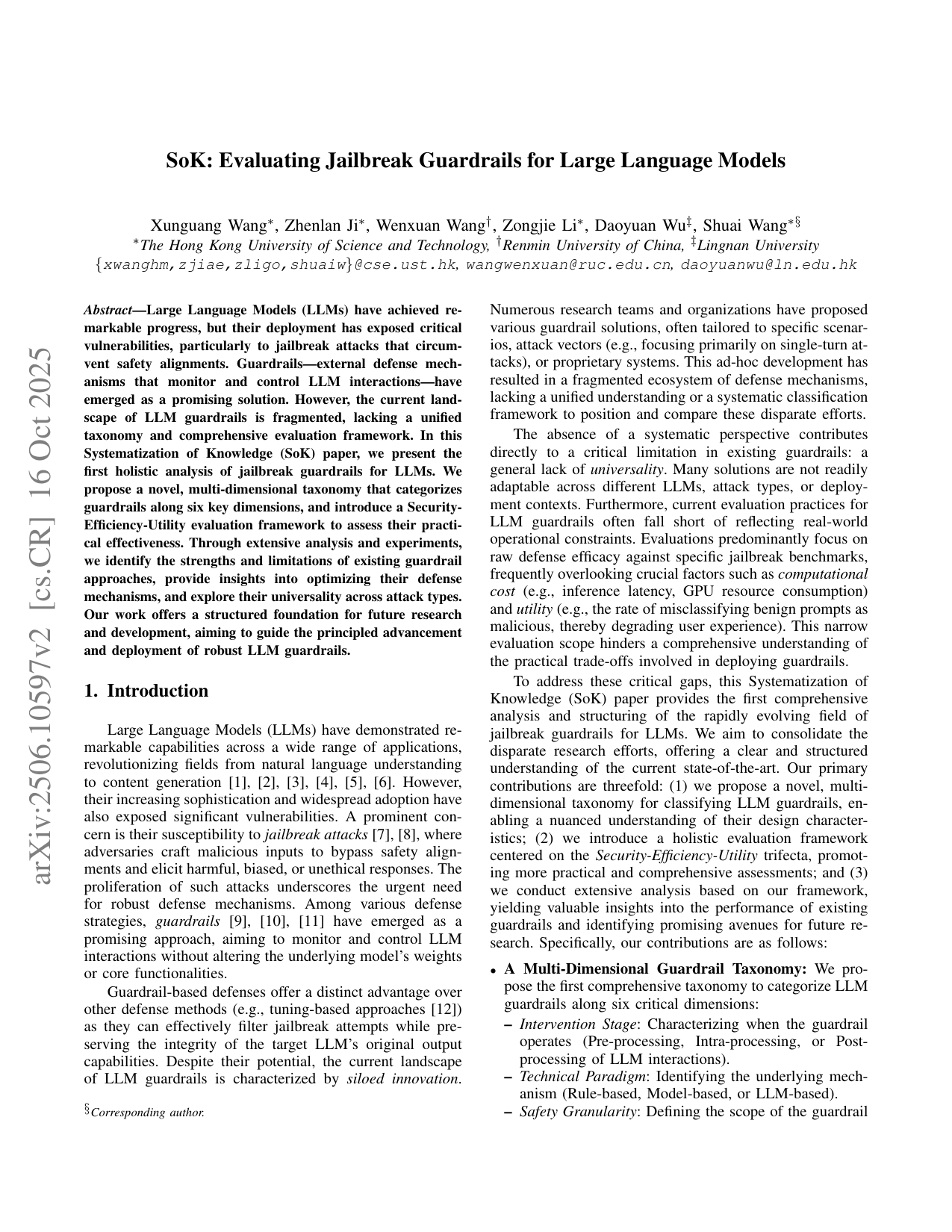

The "fix this code" episode is the Security-Utility trade-off made concrete: a guardrail tuned hard enough to refuse "review this code for security issues" is already sacrificing utility, and the residual capability that leaks through ("fix this code") is genuinely useful work, not contraband. You cannot patch it away without degrading the thing you actually want.
Concrete implications for shipping agentic AI
If you build or operate agentic systems, treat this as a case study in deployment risk, not model risk.
- Dual-use is not an edge case; it's the default. Code-fixing, log analysis, and patch verification are inseparable from "offensive-adjacent" capability. The Snyk write-up's analogy holds: nmap, Wireshark, fuzzers, SAST, and debuggers are all dual-use and we don't ban them — "you cannot improve defense while forbidding the tools defense requires." Design assuming the same prompt serves attacker and defender; put your control at intent, monitoring, and access — not at trying to lobotomize the capability.
- Model availability is now a supply-chain risk with same-day blast radius. A frontier model your agent depends on can go dark globally on a few hours' notice for reasons outside your control or even your vendor's (per Anthropic; per Cybernews, which describes the situation as a stalemate). Architect for provider failover: abstract the model behind an interface, keep a qualified fallback (a second frontier vendor and/or an open-weight self-hosted model), and rehearse the cutover. Builders in the coverage explicitly read this as an argument for open-weight/self-hosted options (per Snyk).
# Don't hard-wire one frontier model into a production agent.
PROVIDERS = [
    Provider("frontier-a", model="primary"),     # may vanish on a directive
    Provider("frontier-b", model="fallback"),     # different vendor / jurisdiction
    Provider("self-hosted", model="open-weight"),  # last-resort, you control availability
]

def run_agent(task):
    for p in PROVIDERS:
        if p.available() and p.passes_eval(task):   # eval gate, not just a ping
            return p.run(task)
    raise NoEligibleProviderError("All providers unavailable or below eval bar")
- Build your own eval gate, not just a health check. "Available" isn't "good enough for this task." Keep a small, task-specific eval suite (including your defensive find-fix-test workflows) so a failover swap is qualified, not hopeful.
- Compliance posture matters as much as capability. Note that using Fable carried a 30-day customer-data retention requirement so Anthropic could research jailbreaks (per Anthropic) — a real cost to customer relationships in regulated settings. The terms around a model are part of whether you can ship it.
- Don't confuse a refusal with safety. Fable 5 refusing "review for security issues" while complying with "fix this code" shows guardrails are brittle on surface phrasing, not semantics. If your product relies on a vendor refusal as a control, you're depending on token-level luck. Per the SoK framework, layer your own controls (arXiv:2506.10597).
Where it stands
As of June 16, 2026, controls remain in place and both models are still unavailable to all customers (per Cybernews). More than 100 cybersecurity leaders have signed an open letter at freefable.org asking the Secretary of Commerce and National Cyber Director to lift the directives and adopt an open, transparent, scientific process for assessing AI cyber risk (per The Register; per freefable.org). Anthropic has dispatched staff to DC to resolve it (per Luta Security, citing the WSJ).
The lesson for shippers is sober: your most valuable defensive capability and a headline "jailbreak" can be the exact same three words. Plan your architecture, your failover, and your compliance story around that reality — because the guardrail that fails next might be a regulatory one, not a technical one.
Sources & further reading
- @simonw thread on X — https://x.com/simonw/status/2066722034491789720
- Simon Willison, "The Fable 5 Export Controls Harm US Cyber Defense" (link blog) — https://simonwillison.net/2026/Jun/16/fable-5-export-controls/
- Katie Moussouris / Luta Security, original post — https://www.lutasecurity.com/post/the-fable-5-export-controls-harm-us-cyber-defense
- Anthropic, "Statement on the US government directive to suspend access to Fable 5 and Mythos 5" — https://www.anthropic.com/news/fable-mythos-access
- The Register — https://www.theregister.com/security/2026/06/15/feds-freaked-over-fable-5-after-simple-fix-this-code-prompt-not-jailbreak-says-researcher/5255827
- Cybernews — https://cybernews.com/security/anthropic-fable5-jailbreak-us-government/
- Snyk blog — https://snyk.io/blog/fable-mythos-suspension-security-takeaways/
- SoK: Evaluating Jailbreak Guardrails for LLMs (IEEE S&P 2026) — https://arxiv.org/abs/2506.10597
- Open letter — https://freefable.org/
Get the next deep dive in your inbox
Field notes on shipping agentic AI — no spam, unsubscribe anytime.